Cosmetics (MoCRA)
The MoCRA Small-Business Exemption Lifts Two Sections of the Statute and Names No Others
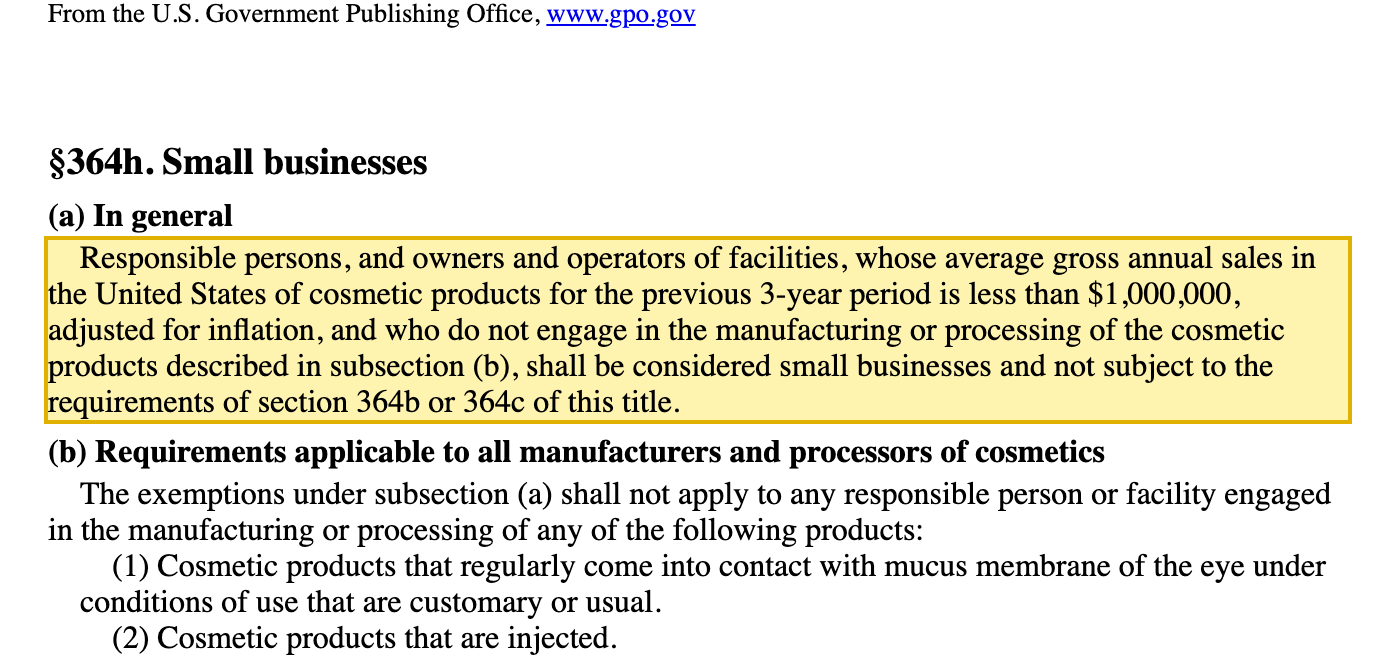
Section 364h of Title 21 exempts a small cosmetics business from exactly two sections: 364b (good manufacturing practice) and 364c (facility registration and product listing).
To qualify, a responsible person or facility owner must average under $1,000,000 a year in U.S. cosmetic sales over the previous three years, adjusted for inflation, and must not make any of four product types.
- LiftedFor a business that meets 364h: good manufacturing practice regulations (364b; FDA has not issued the rule), facility registration and biennial renewal (364c(a)), and product listing (364c(c)). Not if you make any of the four excluded product types.
- Still appliesFor a business that meets 364h: serious adverse event reporting, the label contact line, safety substantiation, FDA records access and recall orders still apply.
- Adverse event records3 years instead of 6, but only if you make none of the four excluded product types.
- ConfirmationFDA will not confirm your status in writing.
Note: This is a reading of statute text and FDA guidance, not legal advice. I checked everything below against the sources named in each section on October 20, 2026.
What does the exemption lift, and what does it leave?
Serious adverse event reporting, the label contact line, safety substantiation, FDA records access and recall orders still apply.
The operative sentence, 21 U.S.C. 364h(a), says such businesses are "considered small businesses and not subject to the requirements of section 364b or 364c of this title." Nothing else in the subchapter is mentioned. The FD&C Act numbers these sections 604 to 614, and FDA's guidance cites them by those numbers, so its "section 612" is 364h.
| Duty | Section | For a business that meets 364h |
|---|---|---|
| Good manufacturing practice regulations | 364b | Lifted (FDA has not issued the rule) |
| Facility registration and biennial renewal | 364c(a) | Lifted |
| Product listing | 364c(c) | Lifted |
| Report each serious adverse event within 15 business days | 364a(a), (b) | Applies |
| Keep adverse event records | 364a(e)(1) | 3 years instead of 6, but only if you make none of the four excluded product types |
| Domestic address, phone or electronic contact on the label | 364e(a) | Applies since December 29, 2024 |
| Keep records showing adequate substantiation of safety | 364d(a) | Applies |
| Give FDA access to records when it reasonably believes a product is likely adulterated and threatens serious harm | 364f | Applies |
| Cease distribution or recall when FDA orders it | 364g | Applies |
The dates come from section 3503(b) of Public Law 117-328. The enforcement amendments take effect "1 year after the date of enactment" (December 29, 2023), and the label requirement in 609(a) "2 years after" (December 29, 2024). The same section makes a cosmetic adulterated if it "does not have adequate substantiation for safety," so a missing safety file is a product defect, not paperwork.
How does the $1,000,000 test work?
To qualify, a responsible person or facility owner must average under $1,000,000 a year in U.S. cosmetic sales over the previous three years, adjusted for inflation, and must not make any of four product types.
Three phrases in 364h(a) carry the test. The sales are "of cosmetic products" and "in the United States." They are averaged over "the previous 3-year period." The figure is "adjusted for inflation," and the statute names no index and no adjusted dollar amount.
FDA's registration and listing guidance adds a footnote recommending "the Implicit Price Deflator for GDP, updated annually by the Bureau of Economic Analysis." The guidance also says it does not "establish legally enforceable responsibilities."
The average can differ from the latest year in either direction. These are invented figures to show the arithmetic:
| Year 1 | Year 2 | Year 3 | Average | Under $1,000,000 before inflation adjustment? | |
|---|---|---|---|---|---|
| Brand A | $600,000 | $900,000 | $1,700,000 | $1,066,667 | No |
| Brand B | $2,200,000 | $400,000 | $300,000 | $966,667 | Yes |
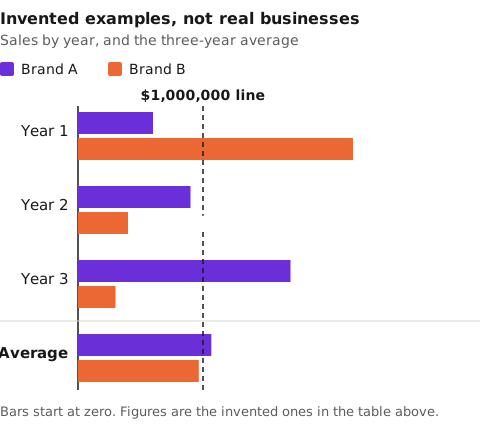
Brand A is only 6.7 percent over the line, which is close enough that an inflation adjustment the statute does not quantify could decide it.
Neither 364h nor FDA's guidance says whether affiliated companies' sales are added together, or on what date the three-year period is measured. One ranking guide fills that gap anyway, covered below. Where the text is silent, treat the question as open and ask counsel.
Which four product types cancel the exemption?
Under 364h(b), the exemptions do not apply to "any responsible person or facility engaged in the manufacturing or processing of" any of these:
- "Cosmetic products that regularly come into contact with mucus membrane of the eye under conditions of use that are customary or usual."
- "Cosmetic products that are injected."
- "Cosmetic products that are intended for internal use."
- "Cosmetic products that are intended to alter appearance for more than 24 hours under conditions of use that are customary or usual and removal by the consumer is not part of such conditions of use that are customary or usual."
FDA's guidance gives examples, in questions 6 and 7 of its Appendix B. For the eye category it expects eye shadow, eye makeup remover, liquid or mucosal eyeliner and false eyelash adhesive to qualify, while "facial cleansers, facial moisturizers, and facial serums generally would not." For the 24-hour category it lists "certain nail polishes, some hair dye products, some eyebrow dyes, tattoo inks, and certain leave-on skin preparations," and tells you to look at the directions for use and at uses "not indicated in the labeling but are customary or usual."
Key takeaway: Question 8 is the one to read twice. A facility whose owner meets the size test but makes any one of the four types must register and give the product information "for all cosmetic products that the facility manufactures or processes," not only the excluded ones.
The statute says "manufacturing or processing." It does not say selling. Two ranking guides state the trigger as making or selling an excluded product, which is wider than the text. Whether a brand that has an outside facility make an excluded product is itself "engaged in" manufacturing is something I found neither the statute nor the guidance answering.
Who registers, and who lists?
Registration and listing fall on different people, and section 364 defines both.
- A facility is an establishment that "manufactures or processes cosmetic products distributed in the United States," and that includes an importer's establishment. An establishment that "solely performs" labeling, relabeling, packaging, repackaging, holding or distributing is not a facility, and "packaging" does not include "filling a product container with a cosmetic product" (364(3)(B)(viii), (C)).
- A responsible person is the "manufacturer, packer, or distributor of a cosmetic product whose name appears on the label."
- A contract facility gets "only a single registration" even when it makes products for several responsible persons, and a responsible person may submit it (364c(a)(3)).
- Listing belongs to the responsible person. One listing may cover products with identical formulations or formulations that "differ only with respect to colors, fragrances or flavors, or quantity of contents" (364c(c)(4)(B)).
For a business that is not exempt, a new product is listed "within 120 days of marketing such product in interstate commerce," and listing updates are due "annually" (364c(c)(2), (c)(5)). The 60-day deadline is for changes to a facility's registration information (364c(a)(4)).
What do sections 364i and 364j change?
Section 364i exempts a cosmetic product or facility "that is also subject to the requirements of subchapter V" (the drug and device provisions) from 364a, 364b, 364c, 364d, 364e(a), 364f and 364g.
A facility that also makes cosmetics not subject to subchapter V gets no exemption for those products. Beauty shops and salons are not facilities unless they manufacture or process cosmetics at that location (364(3)(B)(i)).
Section 364j bars states from imposing any requirement "different from or in addition to, or otherwise not identical with" the federal one on registration and listing, good manufacturing practice, records, recalls, adverse event reporting or safety substantiation. Labeling is not on that list. States may still prohibit an ingredient or limit its amount.
Will FDA confirm that you are exempt?
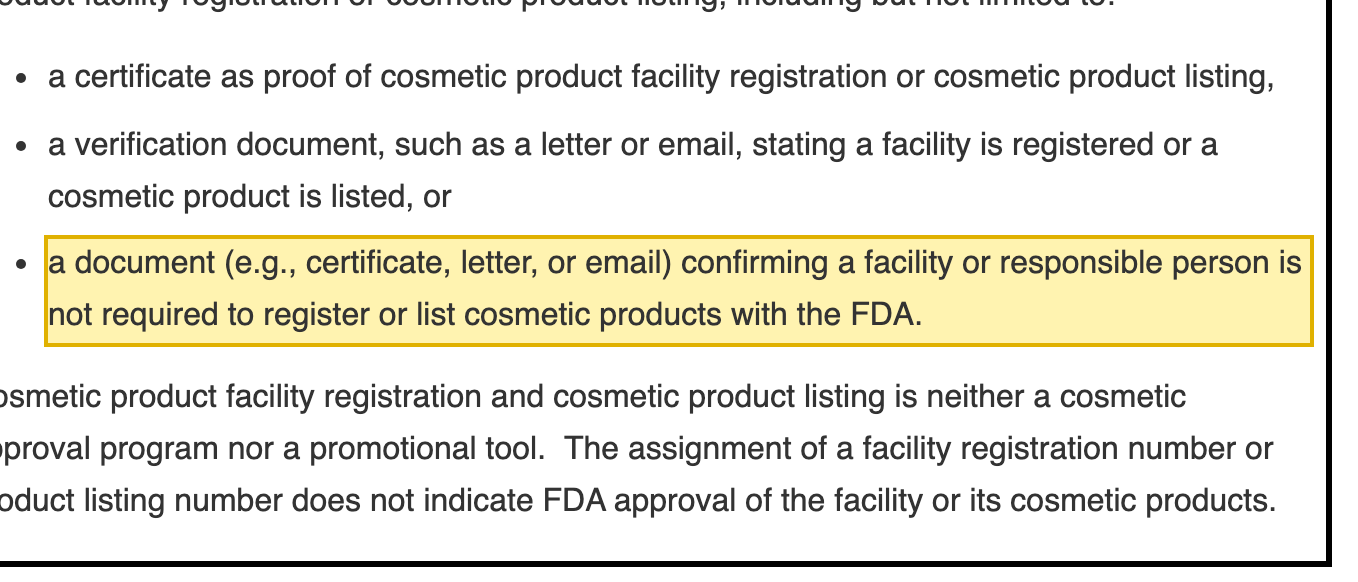
FDA will not confirm your status in writing.
FDA's registration and listing page says it does not issue "a document (e.g., certificate, letter, or email) confirming a facility or responsible person is not required to register or list cosmetic products with the FDA." Question 9 of the guidance says the same about small-business certificates: "FDA is not generally asking companies to submit this information." The sales figures behind the three-year average are the only record of your test, so keep them by year, by U.S. sales and by product line.
Which rules has FDA not issued?
| Rule | Statutory timetable | What I found on October 20, 2026 |
|---|---|---|
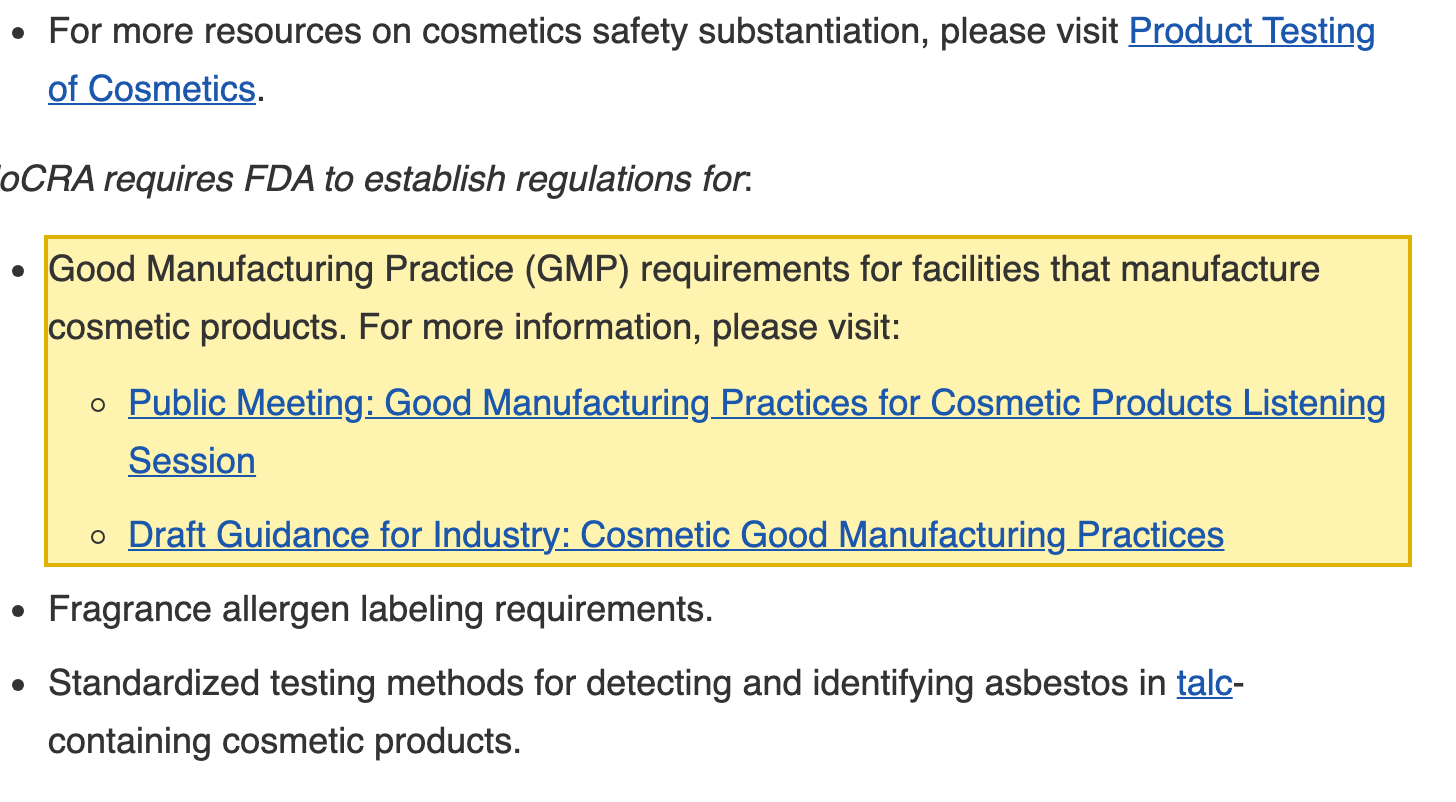
| Good manufacturing practice, 364b(c) | Proposed rule within 2 years and final rule within 3 years of December 29, 2022 | FDA's MoCRA page still lists GMP among regulations it must establish. The only GMP guidance on that page is a June 2013 draft marked "Not for implementation" |
| Fragrance allergen labeling, 364e(b) | Proposed rule within 18 months of December 29, 2022 | Listed on the same FDA page as a regulation FDA must establish |
| Talc-asbestos testing methods, Act section 3505 | Proposed rule within 1 year of December 29, 2022 | Proposed December 27, 2024; withdrawn November 28, 2025 |
When a GMP rule does arrive, 364b(b) says it must "include simplified good manufacturing practice requirements for smaller businesses, as appropriate." A business that meets 364h is outside 364b either way.
The "not issued" entries rest on FDA's own pages and a Federal Register search of FDA proposed rules containing the word "cosmetic" since December 29, 2022. It returned 88 documents, and the only titles that name cosmetic products are the talc proposal and its withdrawal. A keyword search can miss a document, so check the Federal Register before relying on that row.
Where do ranking guides drift from the text?
I read five pages that rank for "mocra small business exemption" against the statute. They agree on the basic test and the four excluded product types. These points do not match the text:
| Guide | What it says | What the statute says |
|---|---|---|
| Registrar Corp | "if a small business manufactures or sells even one non-exempt product, it loses all exemptions" | 364h(b): "engaged in the manufacturing or processing of" |
| Global Cosmetic Regs | Product listing: "Update listings within 60 days of changes" | 364c(c)(5): updates "annually"; the 60-day rule is for registration content |
| Global Cosmetic Regs | Safety records: "Retain records for market period plus 3 years" | 364d(a) says "maintain records" and states no period |
| Global Cosmetic Regs | Sales are counted "before any deductions," include "international sales of US products," and are combined across "all affiliated entities" | 364h(a) counts sales "in the United States" and says nothing about deductions or affiliates; FDA's guidance does not either |
Source note
The statute text above is from the 2024 Edition of the U.S. Code on govinfo.gov, current through January 6, 2025. The House Office of the Law Revision Counsel site returned "Page Not Found" for each section page on October 20, 2026, so I could not compare it with a later release point.
Sources
- U.S. Code, Title 21, section 364h (2024 Edition, govinfo.gov)govinfo.gov
- U.S. Code, Title 21, section 364 (2024 Edition, govinfo.gov)govinfo.gov
- Public Law 117-328, section 3503(b) (govinfo.gov)govinfo.gov
- Registration & Listing of Cosmetic Product Facilities and Products (FDA)fda.gov
- Modernization of Cosmetics Regulation Act of 2022 (MoCRA) (FDA)fda.gov