
Proposition 65
Got a Prop 65 60-Day Notice? The Clock Runs Against the Plaintiff, and a Retailer's Five Days Come With a Catch
This guide applies to
It does not apply to
- A reader looking for a date by which to reply: the 60 days run against the plaintiff, and there is no reply deadline except the 14-day fix for four on-premises exposures (step 3)
- A retailer whose product is private-label, whose label is obscured or who left warning materials undisplayed: the five days do not cure those (step 4)
- Legal advice: this is general information about a statute and regulations, not legal advice
8 steps
- 1Check the notice27 CCR 25903(a), (b); 11 CCR 3100, 3103(a); 25249.7(d)(1)
- 2Count the 60 days27 CCR 25903(d); CCP 1013; CCP 12a
- 3The 14-day fix25249.7(k)
- 4Retailer's five days27 CCR 25600.2(e), (f)(2), (g), (i); OEHHA small-business guidance
- 5Headcount25249.11(b); 27 CCR 25102(h)
- 6Use the wait25249.7(b)(1), (c), (e)(1)(A); Attorney General FAQ
- 7Court ordersAttorney General's Prop 65 page; Personal Care Products Council v. Bonta; California Chamber of Commerce v. Bonta
- 8Before you settleAttorney General FAQ
A Proposition 65 60-day notice does not give you 60 days to answer. It is a waiting period on the person who sent it: under Health and Safety Code 25249.7(d), a private enforcer can sue only if the action "is commenced more than 60 days" after notice and no public prosecutor "has commenced and is diligently prosecuting an action." Use the time to check the notice, count the days, test the product, and fix the exposure if it is real. If you are a retailer, read the five-business-day rule below before relying on it.
Nothing in section 25249.7, in the notice rules at 27 CCR 25903 or in the Attorney General's certificate-of-merit rules at 11 CCR 3100-3103 sets a date by which you must reply, with one narrow exception for four on-premises exposures (covered further down). That doesn't make the period idle. Penalties run up to $2,500 "per day for each violation" under 25249.7(b)(1), and one of the factors a court "shall consider" is "Whether the violator took good faith measures to comply with this chapter and the time these measures were taken."
- Does the notice attach a Certificate of Merit meeting the requirements of subsection 3101(b)? Where it does not, the noticing party "has no authority to commence an action" (step 1).
- How was the notice served, and on what date? The 60 days are counted from the date of service as Code of Civil Procedure 1013 would calculate it (step 2).
- Is the exposure alcoholic beverages consumed on the premises, food or drink prepared and sold on the premises where cooking formed the chemical, environmental tobacco smoke on premises, or engine exhaust in a parking facility? If so, the 14 days run from service of the notice (step 3).
- Are you a retailer? Read the five-business-day rule before relying on it (step 4).
- Did you employ fewer than 10 employees on the date of the exposure? Count heads on the dates in the notice's time period, not today (step 5).
Check the notice before anything else
- What to do
- Mark each of the 12 lines of the check sheet Y, N or ?, and look first at line 10, the Certificate of Merit, which carries the most weight.
- You need
- The notice with its certificate of service and Certificate of Merit (lines 8 and 10), and your headcount on the date of the exposure (line 12)
- Deadline
- No date by which you must reply in section 25249.7, 25903 or 11 CCR 3100-3103, except the 14-day fix for four on-premises exposures (step 3)
- Rule and citation
- 27 CCR 25903(a), (b); 11 CCR 3100, 3103(a); 25249.7(d)(1)
Hide detailsShow details
A notice that misses the regulation's requirements is not a notice. 25903(a) says no one may sue "in the public interest" pursuant to 25249.7(d) "except in compliance with all requirements of this section." Here is a check sheet built from those requirements, one line per item, in the box at the end of this step.
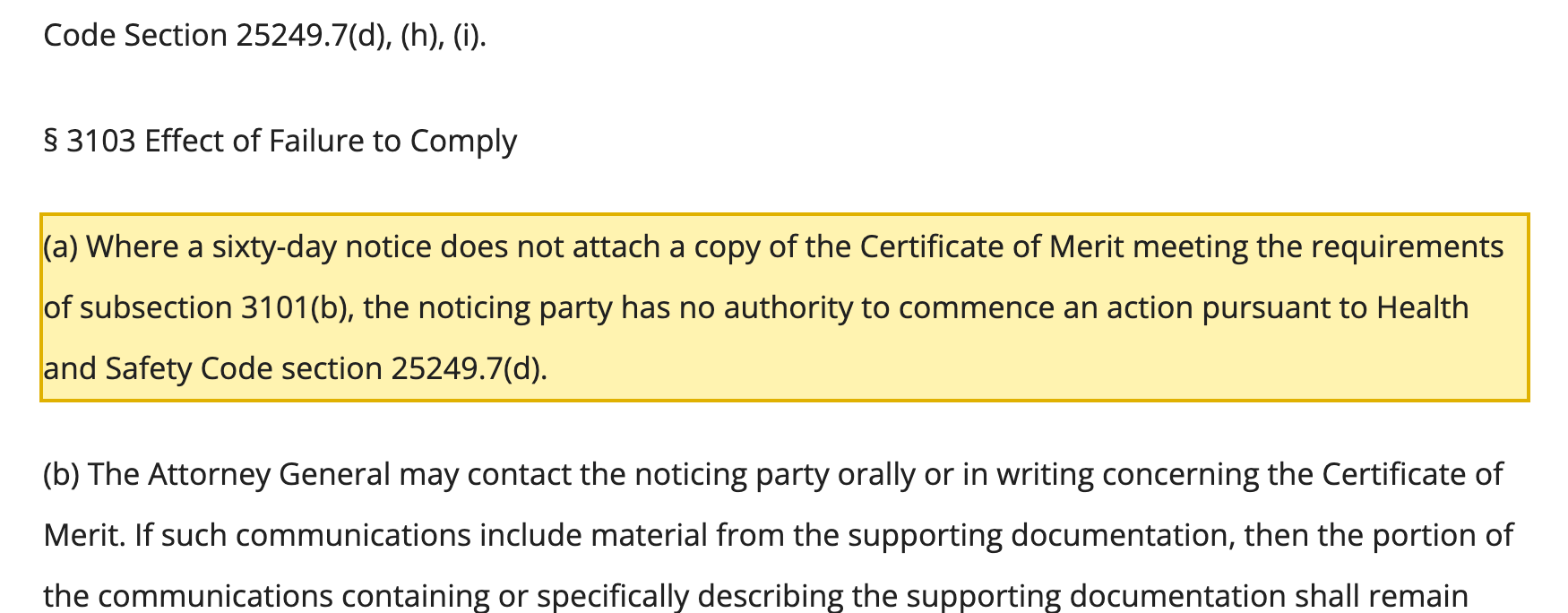
Line 10 carries the most weight. A notice alleging a failure to warn "shall include a Certificate of Merit" (11 CCR 3100), and where the notice "does not attach a copy of the Certificate of Merit meeting the requirements of subsection 3101(b), the noticing party has no authority to commence an action" (3103(a)). The certificate must say the signer consulted someone with relevant expertise who reviewed "facts, studies, or other data regarding the exposure," per 25249.7(d)(1). You won't get that data with the notice: it goes on the Attorney General's copy, which the Attorney General must keep "as confidential official information" under 25249.7(i).
Don't mark the notice defective for what it leaves out on purpose. 25903(b)(4) says a notice is not required to contain "The level of exposure to the chemical in question," the store or date of purchase, the evidence, or "the UPC number, SKU number, model or design number or stock number." A product named by type, with no SKU, can still meet line 6 if the description separates it from the products of yours the notice does not accuse.
PROP 65 60-DAY NOTICE CHECK                       mark Y / N / ?
1  Names the noticing party (name, address, phone)  27 CCR 25903(b)(2)(A)
2  Names the alleged violator(s)                    (b)(2)(A)
3  Gives an approximate time period                 (b)(2)(A)
4  Names each listed chemical                       (b)(2)(A)
5  States the route of exposure                     (b)(2)(C)
6  Names each product or product type closely
   enough to tell it from your other products,
   with a chemical for each                         (b)(2)(D)
7  "A Summary" of Prop 65 attached                  (b)(1)
8  Certificate of service: time, place, manner,
   everyone served                                  (c)(2)
9  Served on you, the Attorney General and the
   district attorney of each county alleged         (c)(3)
10 Certificate of Merit attached                    11 CCR 3100, 3103(a)
11 Date and method of service (for the day count)   (c)(1), (d)
12 Your headcount on the date of the exposure 27 CCR 25102(h)Count the 60 days the way the regulation does
- What to do
- Count from the date of service as Code of Civil Procedure 1013 calculates it, add the mail extension for the method used, and roll a weekend or holiday to the next day that isn't one. Adding the extension before the roll is my reading of 25903(d).
- You need
- The date and method of service (check-sheet line 11); if the plaintiff e-served the Attorney General, time is computed as for mail within California
- Deadline
- More than 60 days from the date of service; mail adds five calendar days (both addresses in California), 10 (either outside California but within the United States) or 20 (either outside the country). Fictional example, served Fri Nov 6, 2026: Tue Jan 5, 2027 to Mon Jan 25, 2027, by method; the sections read don't say which date governs when you, the Attorney General and the district attorneys were served on different days.
- Rule and citation
- 27 CCR 25903(d); CCP 1013; CCP 12a
Hide detailsShow details
The day count is in 25903(d): more than sixty days must have "elapsed from the date of service of the notice, as that date would be calculated for service of a document pursuant to" Code of Civil Procedure 1013. For mail, 1013(a) extends a period by "five calendar days" if both addresses are in California, "10 calendar days" if either is outside California but within the United States, and "20 calendar days" if either is outside the country. If the sixtieth day is a "holiday" under CCP 12a, which includes "all day on Saturdays" and, through CCP 135 and Government Code 6700, "Every Sunday," it moves to the next day that isn't one.
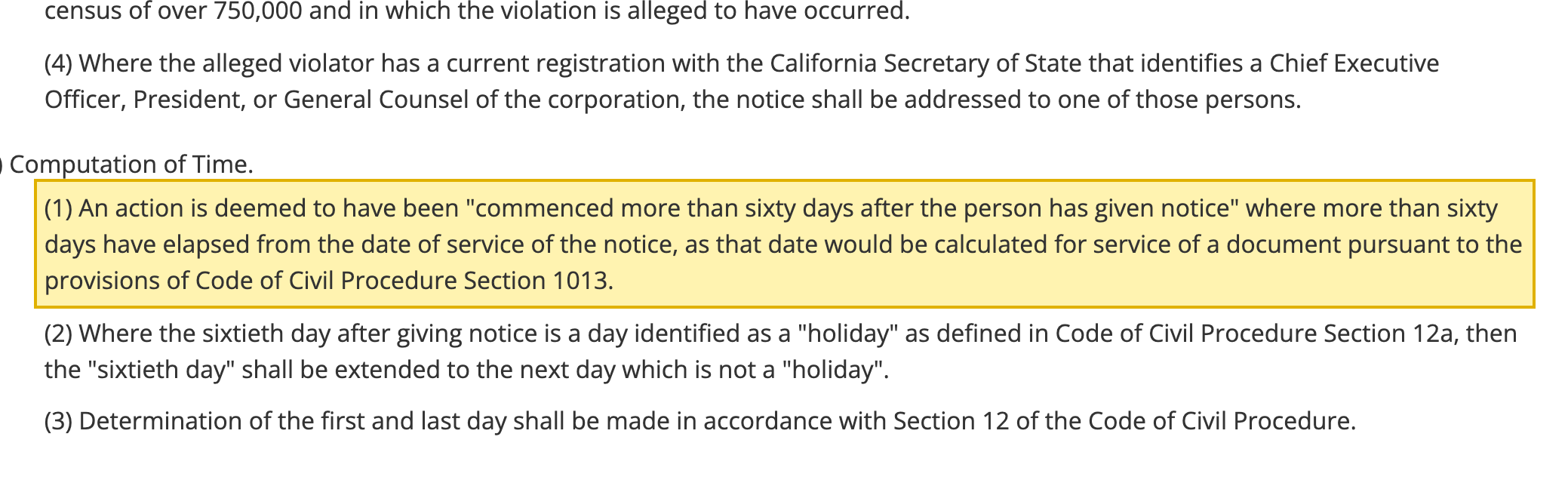
Adding the mail extension to day 60 before applying the holiday roll is my reading of 25903(d), not words the regulation spells out. For a fictional notice served Friday, November 6, 2026, a short script gives:
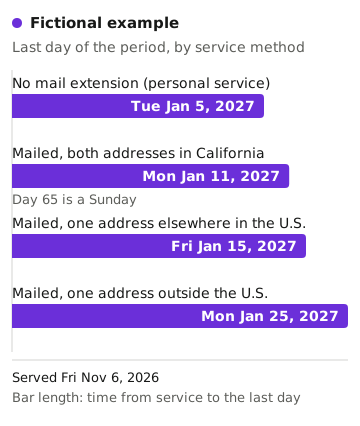
| How it was served | Last day of the period | First day past it |
|---|---|---|
| No mail extension (personal service) | Tue Jan 5, 2027 | Wed Jan 6, 2027 |
| Mailed, both addresses in California | Mon Jan 11, 2027 (day 65 is a Sunday) | Tue Jan 12, 2027 |
| Mailed, one address elsewhere in the U.S. | Fri Jan 15, 2027 | Sat Jan 16, 2027 |
| Mailed, one address outside the U.S. | Mon Jan 25, 2027 | Tue Jan 26, 2027 |
If the plaintiff e-served the Attorney General, 25903(c)(1)(D) says "time shall be computed as it would for service by mail within the State of California." The sections I read don't say which date governs when the Attorney General, the district attorneys and you were served on different days.
The 14-day fix covers four on-premises exposures only
- What to do
- If the exposure is one of the four on-premises kinds, correct the violation, agree to the civil penalty per facility or premises ($500 in the statute, adjusted every five years; $610 from 1 April 2024), and notify the noticing party in writing.
- You need
- One of four exposures: alcoholic beverages consumed on the premises, food or drink prepared and sold there where cooking formed the chemical, environmental tobacco smoke on premises, or engine exhaust in a parking facility. A packaged product shipped to a customer fits none of them.
- Deadline
- Within 14 days after service of the notice; the penalty is paid within 30 days
- Rule and citation
- 25249.7(k)
Hide detailsShow details
25249.7(k) bars suit if, "Within 14 days after service of the notice," the business corrects the violation, agrees to a civil penalty per facility or premises ($500 in the statute, adjusted every five years; $610 from 1 April 2024), and notifies the noticing party in writing, with the penalty paid within 30 days. It applies only to alcoholic beverages consumed on the premises, food or drink "prepared and sold on the alleged violator's premises" where the chemical was formed by cooking, environmental tobacco smoke on premises, and engine exhaust in a parking facility. A packaged product shipped to a customer fits none of them. When one does apply, the noticing party must serve "a notice of special compliance procedure and proof of compliance form" with the notice.
A retailer's five business days only apply in one situation
- What to do
- If you are a retailer, find which of the five 25600.2(e) circumstances makes you responsible before relying on the five business days.
- You need
- Which of (e)(1) to (e)(5) applies: own or affiliate brand, knowingly introduced the chemical, covered or altered a warning label, received warning materials and didn't display them, or actual knowledge where no manufacturer, producer, packager, importer, supplier or distributor both counts as a business under the Act and has a California agent for service of process or a California place of business
- Deadline
- Under (e)(5) only, the retailer is not deemed to have actual knowledge until five business days after it receives the notice; (e)(1) to (e)(4) make you responsible regardless of any notice
- Rule and citation
- 27 CCR 25600.2(e), (f)(2), (g), (i); OEHHA small-business guidance
Hide detailsShow details
OEHHA's small-business guidance and its business FAQ tell retailers they have five business days after receiving a notice to warn or stop selling. That comes from 27 CCR 25600.2(f)(2), and the text is narrower than those summaries suggest.
Under 25600.2(e), a retail seller is responsible for the warning "only when" one of five circumstances exists: it sells the product under its own or an affiliate's brand, it knowingly introduced the chemical, it covered or altered a warning label, it received warning materials and didn't display them, or (e)(5) it has "actual knowledge" of the exposure and no manufacturer, producer, packager, importer, supplier or distributor both counts as a business under the Act and "Has designated an agent for service of process in California, or has a place of business in California."
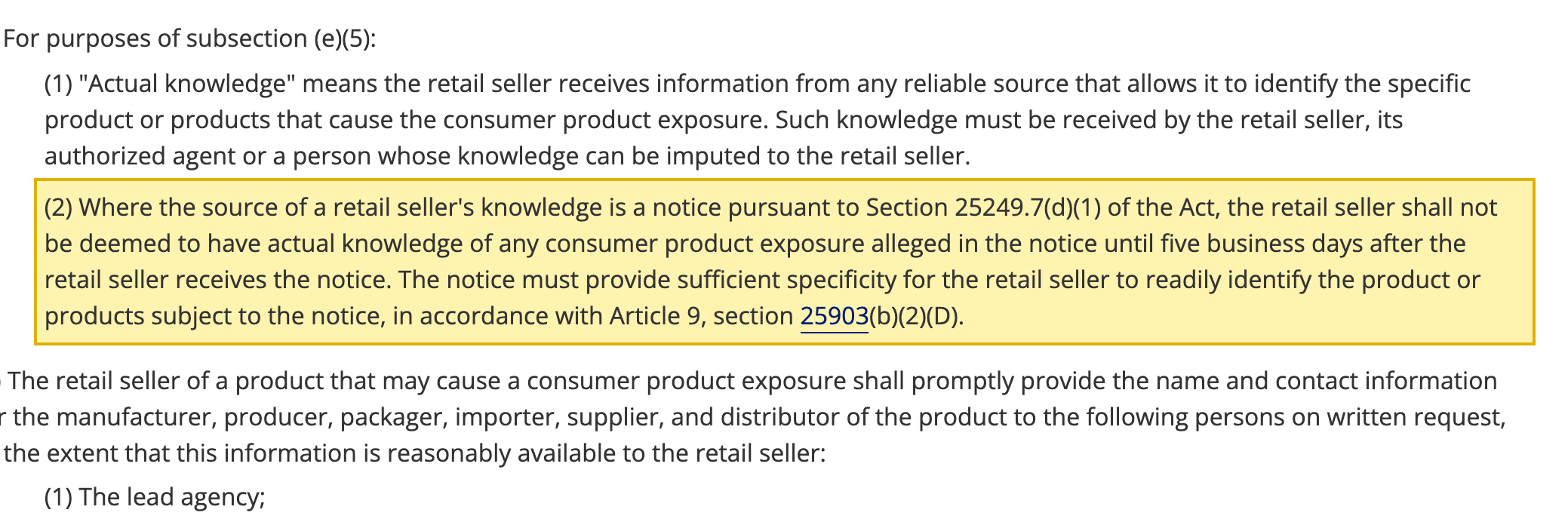
The five days live in subsection (f), which opens "For purposes of subsection (e)(5)". Where the knowledge comes from a 60-day notice, the retailer "shall not be deemed to have actual knowledge" until "five business days after the retail seller receives the notice." So the grace period defines when knowledge starts for the no-reachable-supplier case. It does not cure a private-label product, an obscured label or warning materials you received and left in a drawer, because those make you responsible under (e)(1) to (e)(4) regardless of any notice.
Two other retailer duties are easy to miss:
- Name your suppliers on request. Under 25600.2(g), a retailer "shall promptly provide the name and contact information" for the manufacturer and others in the chain to anyone who served a 60-day notice about the product, on written request, "to the extent that this information is reasonably available."
- Check your supplier contracts. 25600.2(i) lets the businesses in a chain allocate warning responsibility in a written agreement that "shall supersede" subsections (b) through (e), so the contract may decide which of you is responsible for the warning.
Fewer than 10 employees, counted on the exposure date
- What to do
- Count heads on the dates in the notice's time period, not today.
- You need
- All full-time and part-time employees on the date the discharge, release or exposure occurs (check-sheet line 12)
- Deadline
- On the exposure date. The statute says fewer than 10 employees, but 25102(h) says both "ten or fewer" and "ten or more", so at exactly ten the two texts point different ways.
- Rule and citation
- 25249.11(b); 27 CCR 25102(h)
Hide detailsShow details
The Act doesn't reach "any person employing fewer than 10 employees in his or her business" (25249.11(b)). 27 CCR 25102(h) says "all full-time and part-time employees on the date on which the discharge, release or exposure occurs must be counted." So count heads on the dates in the notice's time period, not today. That paragraph also says "ten or fewer" in one sentence and "ten or more" in the next, which doesn't match the statute's "fewer than 10." At exactly ten employees the two texts point different ways, and I found nothing in the regulation that explains it. OEHHA's guide adds that a small business may still owe compliance under its contracts, such as indemnification agreements.
What the Attorney General can do while you wait, and what to do with the time
- What to do
- Run lab testing or an exposure assessment, and if the claim may be valid, take the FAQ's measures: cease sale, instruct retail customers to stop selling, recall the product, and/or provide proper warnings.
- You need
- Testing or data. You may ask the noticing party for it, but "the plaintiff is not required to provide this information."
- Deadline
- No reply deadline. In setting the civil penalty (up to $2,500 "per day for each violation"), a court "shall consider" whether the violator took good faith measures "and the time these measures were taken."
- Rule and citation
- 25249.7(b)(1), (c), (e)(1)(A); Attorney General FAQ
Hide detailsShow details
During the period, 25249.7(c) lets the Attorney General, a district attorney or certain city attorneys and prosecutors bring the case themselves. The Attorney General's FAQ says it "decides whether to file suit on a case-by-case basis." If it believes the case lacks merit, the Attorney General "shall serve a letter to the noticing party and the alleged violator" saying so ((e)(1)(A)); the absence of a letter "shall not be construed as an endorsement" of the case.
The FAQ's own advice for a served business: "should consider locating defense counsel to help evaluate the matter," contact the noticing party for testing or data ("the plaintiff is not required to provide this information"), run lab testing or an exposure assessment, and if the claim may be valid, "cease sale of the product, instruct retail customers to stop selling the product, recall the product, and/or provide proper warnings." When you write to the noticing party, the FAQ notes it may ask for information "which you are not required to provide."
Two federal court orders to check against the notice
- What to do
- Check the notice against the two orders: titanium dioxide in cosmetics and personal care products, and the dietary acrylamide warning.
- You need
- The product and chemical named in the notice, and, for acrylamide, whether you are a Chamber member or someone it represents
- Deadline
- Titanium dioxide order entered August 12, 2025; acrylamide order entered May 2, 2025. The Attorney General's page says the Ninth Circuit dismissed the state's appeal of the acrylamide order on May 29, 2026, on the Attorney General's own motion.
- Rule and citation
- Attorney General's Prop 65 page; Personal Care Products Council v. Bonta; California Chamber of Commerce v. Bonta
Hide detailsShow details
The Attorney General's Prop 65 page posts two permanent injunctions from the Eastern District of California:
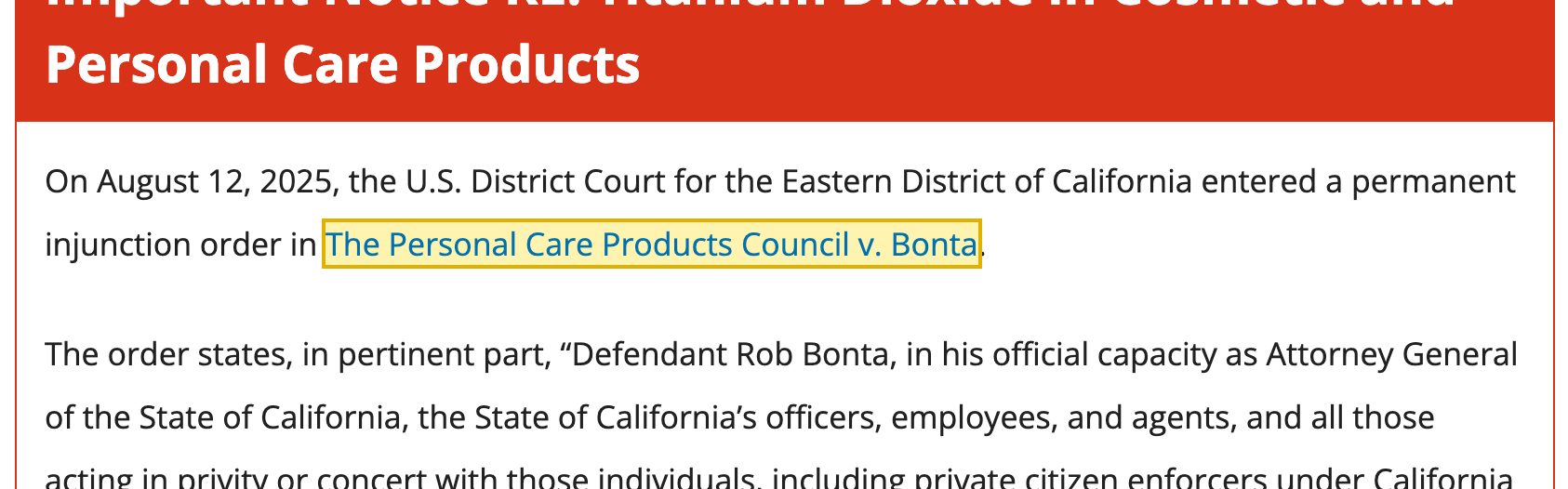
- Titanium dioxide in cosmetics. Entered August 12, 2025 in Personal Care Products Council v. Bonta, it enjoins the state and "private citizen enforcers under California Health & Safety Code § 25249.7(d)" from "filing or prosecuting new lawsuits" on the cancer warning "as applied to Listed Titanium Dioxide (i.e., titanium dioxide that consists of airborne, unbound particles of respirable size) in cosmetics and personal care products."
- Acrylamide in food. Entered May 2, 2025 in California Chamber of Commerce v. Bonta, it enjoins enforcement of the dietary acrylamide warning "as against California Chamber of Commerce, its members, and all persons its represents." The page says the Ninth Circuit dismissed the state's appeal on May 29, 2026, on the Attorney General's own motion.
Whether the acrylamide order covers you depends on whether you are a Chamber member or someone it represents. The page tells litigants they "are responsible for tracking the progress of this case."
Settling before a lawsuit is filed
- What to do
- Before you sign a pre-suit deal, read the FAQ's rule of thumb on what the plaintiff can release.
- You need
- The proposed out-of-court settlement
- Rule and citation
- Attorney General FAQ
Hide detailsShow details
Before you sign a pre-suit deal, read the FAQ's "rule of thumb": an out-of-court settlement lets the plaintiff release claims "on its own behalf, but not 'in the public interest,'" so "a different private plaintiff or public enforcer could sue you over those violations."
Your notice checklist
What this guide is
This is general information about a statute and regulations, not legal advice. The 27 CCR text above is Cornell LII's copy of the California Code of Regulations, read October 20, 2026.
Sources
- Health and Safety Code 25249.7 (HSC)leginfo.legislature.ca.gov
- Health and Safety Code 25249.11 (HSC)leginfo.legislature.ca.gov
- 27 CCR 25903, Notices of Violation (CCR, Cornell LII)law.cornell.edu
- 27 CCR 25600.2, Responsibility to Provide Consumer Product Exposure Warnings (CCR, Cornell LII)law.cornell.edu
- 27 CCR 25102 (CCR, Cornell LII)law.cornell.edu
- Code of Civil Procedure 1013 (CCP)leginfo.legislature.ca.gov
- Code of Civil Procedure 12a (CCP)leginfo.legislature.ca.gov
- Code of Civil Procedure 135 (CCP)leginfo.legislature.ca.gov
- Government Code 6700 (GOV)leginfo.legislature.ca.gov
- 11 CCR 3100-3103, certificate of merit regulations (OAG)oag.ca.gov
- Proposition 65 page with the two court orders (OAG; E.D. Cal.)oag.ca.gov
- Proposition 65 FAQ (OAG)oag.ca.gov
- Small-business guidance on the 60-day notice (OEHHA)p65warnings.ca.gov